Table of Contents
- What Is Frozen Shoulder?
- The Three Stages of Frozen Shoulder
- Who Gets Frozen Shoulder and Why?
- How It Is Diagnosed
- Physiotherapy Treatment for Each Stage
- Home Exercises That Help
- Recovery Timeline: What to Realistically Expect
- Frequently Asked Questions
If your shoulder has become so stiff and painful that reaching overhead, fastening clothes behind your back, or even sleeping on that side feels impossible, you may be dealing with frozen shoulder. It is a frustrating condition — but it is also one that physiotherapy manages very well, provided treatment matches the stage you are in.
What Is Frozen Shoulder?

Frozen shoulder — medically called adhesive capsulitis — happens when the capsule surrounding the shoulder joint becomes inflamed, thickened, and tight, limiting the joint’s freedom to move.
- Gradual onset of shoulder pain, often worse at night
- Progressive stiffness — losing the ability to lift your arm or reach behind your back
- Pain with attempted movement, especially sudden movements
- Difficulty with daily tasks — dressing, combing hair, reaching shelves
The Three Stages of Frozen Shoulder
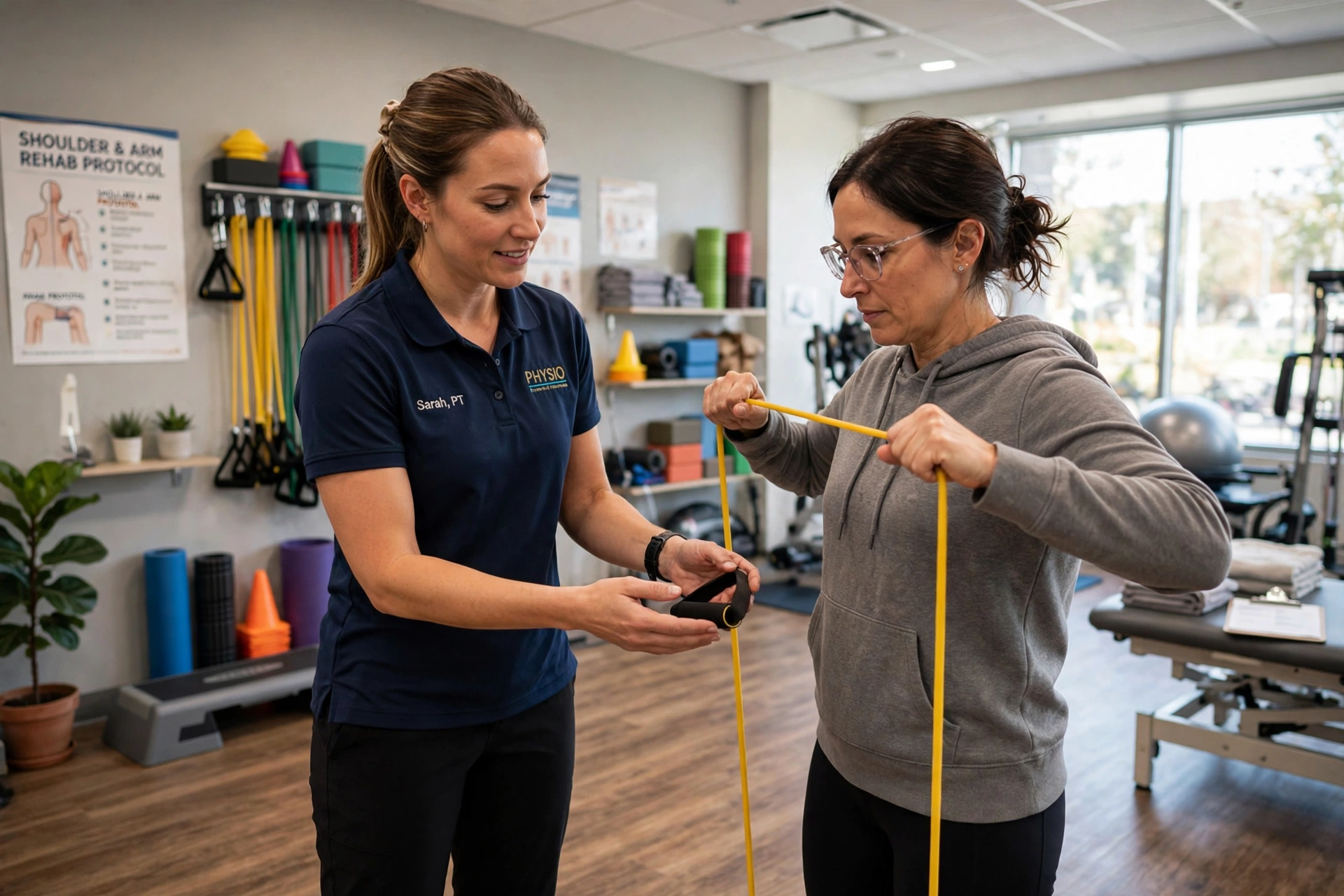
Stage 1: Freezing (2–9 months)
Pain dominates. The shoulder becomes increasingly painful, especially at night, and stiffness gradually builds. Treatment focus: pain control and gentle mobility — aggressive stretching can flare symptoms.
Stage 2: Frozen (4–12 months)
Pain eases but stiffness peaks. Treatment focus: progressive mobilisation — graded joint mobilisations and carefully progressed exercises.
Stage 3: Thawing (6 months–2 years)
Movement gradually returns. Treatment focus: strengthening and functional retraining.
Total course: typically 1 to 3 years — but with proper physiotherapy, the painful period is substantially shortened.
Who Gets Frozen Shoulder and Why?

Most common between 40 and 60 years old, slightly more in women. Key risk factors: diabetes (strongest risk factor), thyroid disorders, previous shoulder injury/surgery with immobilisation, and prior frozen shoulder in the other shoulder.
Physiotherapy Treatment for Each Stage
Freezing stage — calm the fire
- Pain-relieving modalities and gentle pendulum exercises
- Sleep positioning advice
- Postural correction
Frozen stage — restore the movement
- Graded joint mobilisation — the most effective intervention for the stiff phase
- Dry needling of surrounding guarded muscles
- Progressive active-assisted exercises
Thawing stage — rebuild the strength
- Rotator cuff and scapular stabiliser strengthening
- Functional training for daily tasks
Home Exercises That Help
- Pendulum swings — the safest exercise for the painful freezing stage.
- Wall crawls (finger walks) — ‘walk’ fingers up a wall as far as comfortable.
- Cross-body stretch — hold 20–30 seconds.
- Towel stretch behind the back — for internal rotation.
Do these daily, gently, never forcing through sharp pain.
Frequently Asked Questions
Will frozen shoulder go away on its own?
It often eventually ‘thaws’ over 1–3 years, but physiotherapy shortens the painful period dramatically and ensures you recover function, not just reduced pain.
Is it safe to exercise a frozen shoulder?
Gentle, graded exercise is safe and is the main treatment — but type and intensity must match your stage. A physiotherapist calibrates the programme.
I have diabetes. Does that change my treatment?
The approach is the same, but expect a somewhat longer timeline. Good blood sugar control during rehabilitation genuinely helps outcomes.
About the author: Dr Nimra Kiran, Physiotherapist (DPT) — Doctor of Physical Therapy (DPT), GCUF, practising at Alnoor Clinic, Layyah. Experienced in musculoskeletal and orthopaedic rehabilitation including manual therapy, joint mobilisation, dry needling, and therapeutic exercise prescription, with clinical training across orthopaedic, ICU, and OPD settings.
Reviewed by Dr Nimra Kiran, DPT
Related posts:
- Dry Needling vs Cupping Therapy: Which Is Right for Your Pain?
- Neck Pain from Poor Posture: Correction Exercises That Work
- Sports Injury Rehabilitation: Step-by-Step Recovery Timeline
Educational disclaimer: This article is for information only and is not medical advice. Please consult a qualified physiotherapist for diagnosis and treatment of your condition.